
FAAC Gate Repair in Jurupa Valley: A Homeowner’s Guide
FAAC gate repair in Jurupa Valley usually comes down to one of three things: degraded hydraulic fluid, a failed seal, or a fouled solenoid valve. The operator itself is rarely the problem, which is why the right diagnosis matters more than the repair itself. That’s the short answer. If your FAAC gate is crawling, stalling, or refusing to move, a brand-specific technician will find the actual cause before replacing a single part. If you’d rather skip the research and get it fixed, call (866) 383-9857.
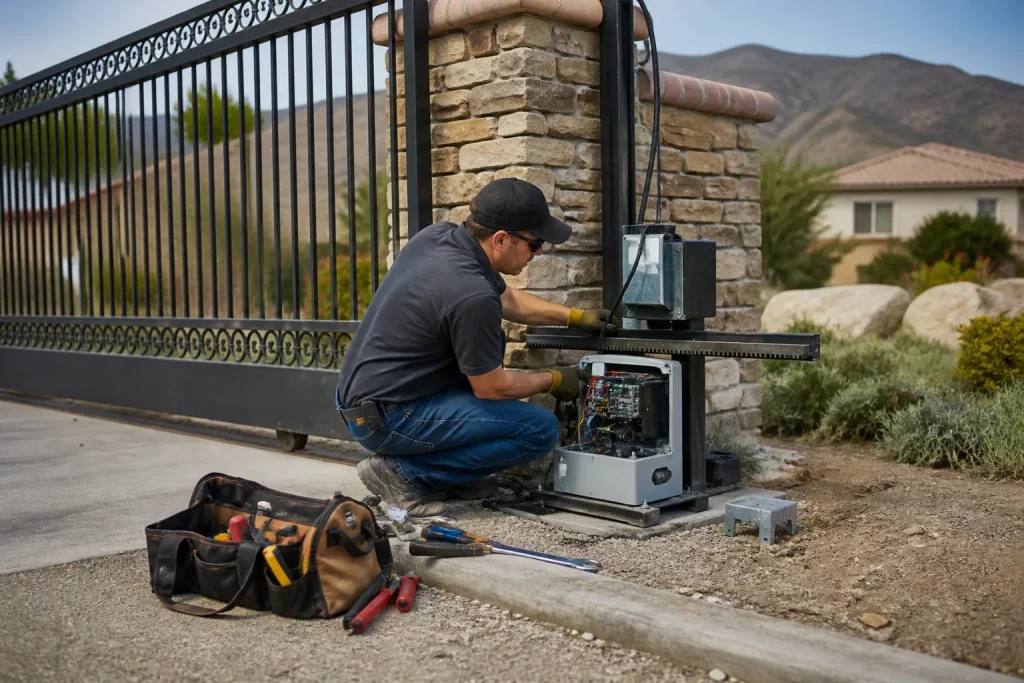
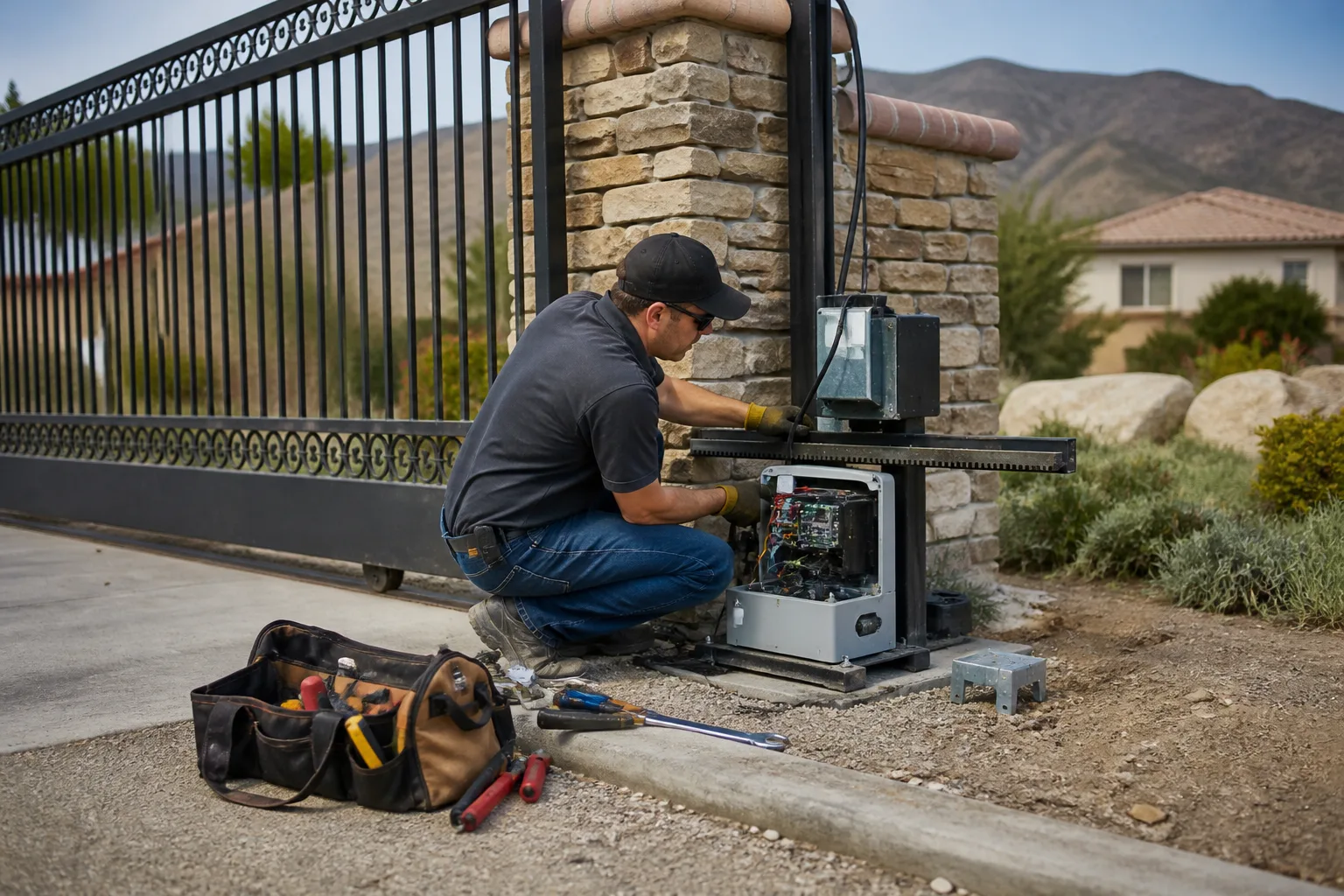
Here’s the thing most homeowners in Jurupa Valley don’t know about their FAAC operator: it’s probably not broken. FAAC builds hydraulic systems, not electromechanical ones. The difference sounds technical, but it changes everything about how your gate fails, what it costs to fix, and who should be opening the cabinet.
Why FAAC Operators Confuse Generalist Technicians
FAAC hydraulic operators work on a completely different principle than the electromechanical operators most gate technicians train on. An electromechanical unit uses a motor and a gearbox to move a mechanical arm. A FAAC unit uses a motor to drive a hydraulic pump, which pressurizes fluid that moves a piston, which moves your gate. There are no gears to strip. There are no drive belts to snap. Instead, there’s a sealed hydraulic circuit with oil, seals, and valves under pressure.
The problem is that most gate training in the United States focuses on electromechanical systems, because that’s what most brands install. Brands like Gate Repair in Jurupa Valley teams encounter daily, Linear and Ghost Controls, dominate the residential electromechanical market. When a technician with that background opens a FAAC unit and finds a motor that hums but doesn’t turn the gate, the electromechanical playbook says replace the motor. In a FAAC, that motor is probably fine. The hydraulic pump isn’t building pressure because the fluid has degraded, or a seal is bypassing internally, or a solenoid isn’t actuating.
We’ve replaced the aftermarket parts installed by those previous technicians more times than we can count. The homeowner paid for a motor swap, waited a week, and the gate worked for a month before the same symptom came back. The hydraulic issue never went anywhere.
How Heat in Jurupa Valley Kills FAAC Hydraulic Systems Faster
Summers in Jurupa Valley routinely push above 100 degrees, and that heat does real damage to any hydraulic gate operator over time. FAAC systems are built in Italy, where the operating-temperature assumptions are different from a Riverside County summer. What we see most often in Jurupa Valley, especially in neighborhoods like Mira Loma and Pedley, is hydraulic fluid that has thinned or contaminated from heat cycling.
Fluid degradation causes sluggish operation first, then intermittent stalls, then complete failure. The motor keeps running, the pump keeps spinning, but the fluid can’t build enough pressure to move the piston under load. Homeowners misinterpret the symptom as a weak motor. Technicians who don’t know FAAC replace the motor. The correct repair is a fluid flush, filter replacement, and seal inspection.
Seal shrinkage is the second heat-related failure. Hydraulic seals are elastomeric, and years of hot days followed by cool Jurupa Valley nights cause them to shrink and harden. Once a seal shrinks, fluid bypasses it internally. The pump still spins, but pressure drops, and the gate moves progressively slower until it won’t move at all. Internal bypass is invisible without pressure testing, which is exactly why a specialist who knows FAAC diagnostics beats a generalist with a parts catalog.
The third common heat-and-dust failure is solenoid valve fouling. Jurupa Valley sits in a dry, dusty climate. Dust finds its way into the operator cabinet through ventilation ports, then settles on the solenoid valves that control hydraulic fluid direction. Over time, the valve stem sticks. Your gate might open fine but refuse to close, or close fine but refuse to open. That’s a directional valve issue, not a motor issue, not a board issue. The fix is cleaning or replacing the solenoid, not replacing the operator.
How to Identify Your FAAC Model Before You Call
FAAC shipped different model families over the decades, and the repair approach differs meaningfully between them. You’ll find the data plate on the side or rear of the operator housing. That plate carries your model number, serial number, hydraulic fluid type, and often the year of manufacture. Write down the full model number before you make the first phone call.
- 400 series (402, 412, 415, 422): The classic residential swing-gate workhorse. Hydraulic piston system, simple controls, widely installed across older Jurupa Valley properties. Parts are still available, but aftermarket substitution is common. Pressure ratings are lower than the commercial lines.
- 615 and 620: The compact hydraulic operators used on lighter residential gates and some pedestrian gates. Common failure points are internal seals and the capacitor on the pump motor.
- 760 series: The commercial-grade line, built for heavier gates and higher cycle counts. These have larger fluid reservoirs, higher pressure ratings, and more complex control boards. If you have a 760 on a residential property, it was likely over-specified, which is good news for longevity and bad news for repair cost if someone misdiagnoses it.
One model number changes the fluid type, the seal kit, and the repair procedure. We’ve had Jurupa Valley homeowners call us after a technician ordered “generic FAAC parts” online and installed them in a 760. The pressure rating on those aftermarket seals didn’t match the system spec, and the gate failed again within a season.
Genuine FAAC Parts vs. Aftermarket Substitutes
This section matters more than most homeowners expect. FAAC hydraulic systems operate at specific pressure thresholds designed around genuine seals, genuine solenoids, and genuine fluid specifications. Aftermarket parts are cheaper, sometimes half the price, but they’re manufactured to approximate tolerances, not FAAC’s engineering specs.
A seal kit is a seal kit until it isn’t. We’ve installed genuine FAAC seal kits in 400-series operators that held pressure perfectly for years. We’ve also removed aftermarket seals that failed within twelve months because the material spec didn’t match the hydraulic fluid FAAC recommends. The same applies to solenoid valves: aftermarket valves may fit the housing, but if the coil resistance isn’t matched to the FAAC control board, the board eventually fails. A $90 valve substitute becomes a $600 board replacement.
Warranty coverage is another factor. FAAC’s warranty on structural and hydraulic components typically applies only when genuine parts are used and the installation follows FAAC procedures. If a previous repair used aftermarket parts and something fails later, the warranty on the affected components is void even if the failure wasn’t directly caused by those parts. Before any technician opens your FAAC unit, ask what parts they’ll use and whether they’re genuine FAAC. If the answer is vague, that’s your answer.
Questions to Ask Any Technician Before They Open Your FAAC Unit
You don’t need to be a gate technician to tell whether the person you’ve called knows FAAC. You just need to ask the right questions and listen for specific answers rather than general reassurances.
- “What’s the first thing you check on a FAAC that’s moving slowly?” The correct answer involves hydraulic fluid condition or pressure testing. If they say “the motor,” you should probably keep looking.
- “Do you stock FAAC seal kits and solenoids, or are you ordering them?” A brand-specific technician in Jurupa Valley either stocks them or has a direct supplier relationship. A technician who sources from a general parts website is guessing.
- “Have you worked on a 760 series before?” If the answer is “I’ve worked on FAAC” without specifying models, that’s a weaker signal than a technician who says “yes, and the 760 uses a different control board than the 400 series.”
- “Will you pressure-test the hydraulic circuit before replacing anything?” This is the diagnostic step that separates FAAC specialists from generalists. If they don’t pressure-test, they’re replacing parts on hope.
We work on FAAC units regularly, alongside electric gate repair for brands like Viking and DoorKing. The brands differ mechanically, but the diagnostic discipline is the same: identify the symptom, test the system, confirm the failure, then replace only what failed. When we encounter a FAAC after another company has already attempted a repair, the first thing we do is inspect what was replaced and whether it needed to be.
Cold Morning Sluggishness: The Symptom That Confuses Everyone
Jurupa Valley gets cold enough on winter mornings that a FAAC hydraulic gate will sometimes move noticeably slower on the first opening cycle of the day. If you search for this symptom online, you’ll find a lot of panic about failing motors and imminent breakdowns. The reality is simpler and less expensive.
Hydraulic fluid gets thicker as the temperature drops. That’s viscosity, and it’s how hydraulic systems are supposed to behave. FAAC specifies hydraulic fluid grades that work across a temperature range, but in cold conditions, every hydraulic system moves slower until the fluid warms from circulation. This is normal behavior, not a failure. If your gate returns to normal speed after two or three cycles on a cold morning, the system is functioning correctly.
The problem arises when technicians don’t understand this. We’ve seen Jurupa Valley homeowners spend hundreds of dollars replacing a motor because a technician observed the gate moving slowly on a cold morning and concluded the motor was weak. The motor was fine. The fluid was cold. That’s what hydraulic fluid does in January. A brand-specific FAAC technician knows this, because it’s one of the first things you learn when you actually work on hydraulic operators rather than reading about them.
If the slow operation persists after the day warms up, or gets worse over weeks regardless of temperature, then you have a genuine fluid degradation or seal problem. But if the symptom only appears on cold mornings and clears within minutes, relax. Your gate is behaving like a hydraulic system behaves.
When to Call a Pro (And When to Wait)
Not every FAAC issue needs a service call. If your gate is slow on cold mornings but recovers, that’s normal viscosity behavior as explained above. If you hear a faint hum from the cabinet but the gate moves fine, that’s the pump circulating fluid. If the gate operates normally but the remote range has shortened, the remote battery is likely dying, not the gate.
Call a professional when any of these appear: the gate stalls mid-cycle and won’t resume without a manual release, the gate moves at significantly different speeds in each direction, you hear grinding or squealing from the operator itself, the gate won’t hold position at the open or closed limit, or you notice hydraulic fluid leaking from the housing or the piston. Any of these indicate a real problem that won’t resolve on its own.
If you’re in Jurupa Valley and any of those symptoms sound familiar, call a FAAC-experienced technician rather than waiting. Hydraulic problems compound: a leaking seal leads to low fluid, low fluid leads to pump cavitation, and pump cavitation damages the pump. What starts as a $200 seal replacement becomes a $900 pump replacement if it runs long enough. If you need Gate Installation in Jurupa Valley instead because the operator has reached end of life, a specialist can handle that transition too.
The Bottom Line
FAAC operators are over-engineered, which means they last a long time when maintained and mislead people badly when they fail. The most common Jurupa Valley FAAC problems are hydraulic fluid degradation from heat, seal shrinkage from temperature cycling, and solenoid fouling from dust. None of those are motor failures, but all of them get misdiagnosed as motor failures by technicians who don’t know the brand.
If your FAAC gate is misbehaving, get the model number off the data plate, ask the questions above, and make sure the person opening the cabinet knows hydraulic systems, not just gate openers. If you’re in Jurupa Valley and need help, Gate Repair Jurupa Valley home is a gate specialist with direct FAAC experience across the residential and commercial lines. We diagnose first and quote before we start, so you know what you’re paying for before any work happens. Call (866) 383-9857 for a free estimate.
Frequently Asked Questions
FAAC gate repair in Jurupa Valley typically ranges from $150 for a solenoid cleaning or fluid top-off to $400 – $900 for seal replacement or pump work, depending on the model and what failed. The exact cost depends on whether you need a fluid flush, a seal kit, a solenoid, or a board. Call (866) 383-9857 for an exact quote. Estimates are free, and the price is agreed before any work starts.
Many FAAC issues can be diagnosed and repaired the same day if the required parts are in stock, which they often are for the 400 series and common solenoid failures. Less common 760-series components may require ordering. Call (866) 383-9857 to confirm availability and schedule a diagnosis.
Your FAAC gate moves slowly on cold mornings because its hydraulic fluid thickens at lower temperatures, which is normal behavior for hydraulic systems. If the gate returns to normal speed after a few cycles, no repair is needed. If the sluggishness persists regardless of temperature, the fluid has likely degraded and needs replacement.
Both. We service existing FAAC operators and install new FAAC systems when an existing unit has reached the end of its service life. Since we handle repair and installation as one company, you won’t need to source a separate installer if your current operator is beyond repair. Call (866) 383-9857 for a free measure and written price.
Written by the team at Gate Repair Jurupa Valley, serving Jurupa Valley since 2015.
Need Gate Repair Help?
Call Gate Repair Jurupa Valley - licensed & insured, here with fast help in Jurupa Valley.
(866) 383-9857